Monoclonal reliability platform
Reliability pipelines for monoclonal & bispecific antibodies.
ChimeraBio turns clone screening, 3D structural marking and bioanalysis into one auditable pipeline. A retrieval-grounded AI agent reads your assay records, segments clone populations, and models bispecific binding flow before you burn a single plate.
- 3D
- Structure-aware QC
- RAG
- Grounded on your assays
- 2×
- Bispecific flow modelling
The pipeline
From raw clone data to a defensible reliability call.
Five stages, one continuous record. Each stage writes back to the clone registry, so the reasoning behind every decision stays inspectable.
- 01
Ingest & clone registry
Upload sequences, titer runs, SPR/BLI traces and plate metadata. Every clone gets a versioned record with provenance you can audit later.
- 02
RAG cloning segmentation
The agent retrieves against your own assay corpus and literature, then segments clone populations by expression stability, aggregation risk and developability flags.
- 03
3D structural marking
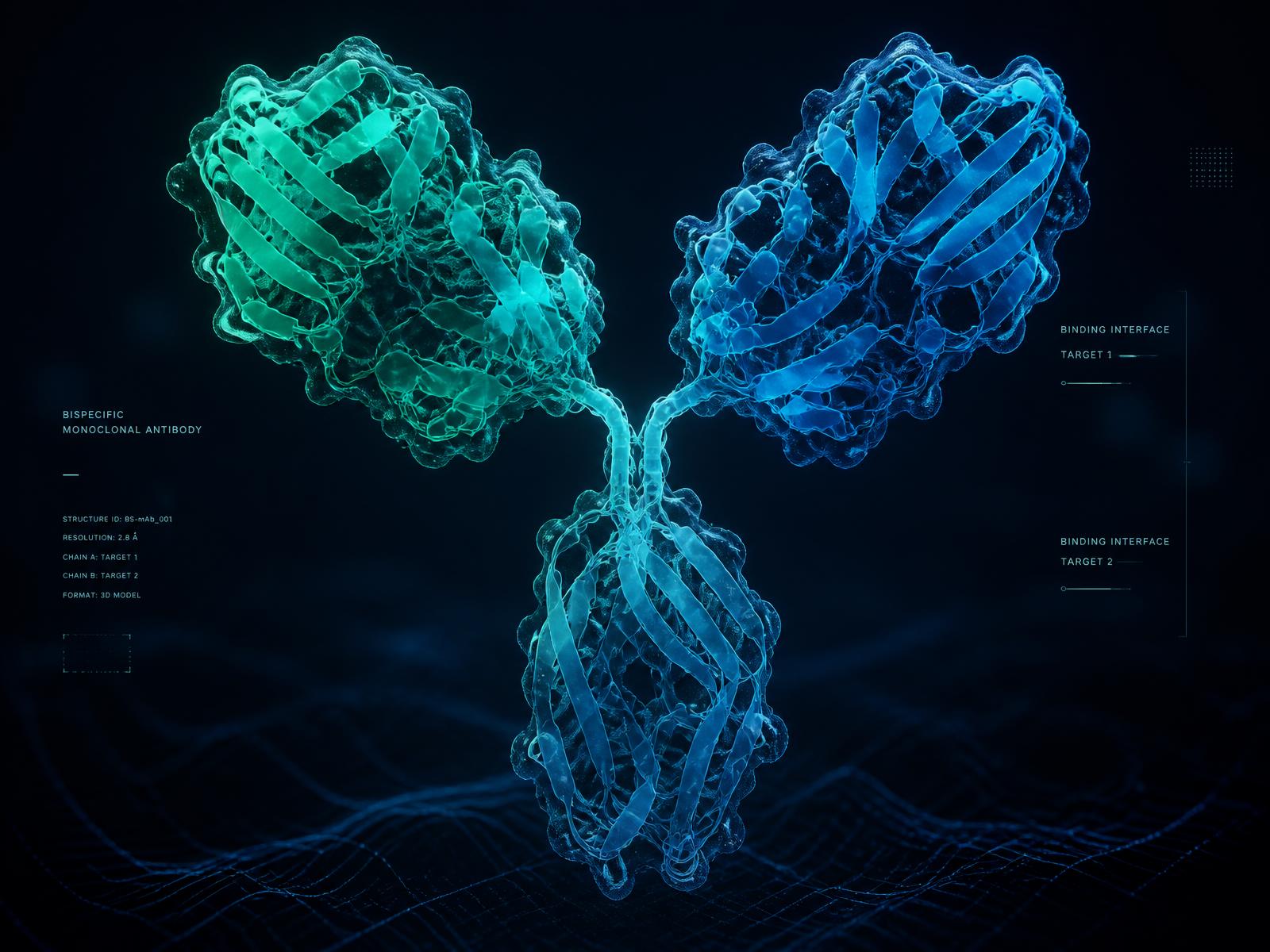
Interactive 3D models mark CDR loops, epitope patches and liability motifs — deamidation, oxidation, glycosylation — directly on the structure.
- 04
Bispecific flow modelling
Simulate dual-arm binding kinetics, chain-pairing efficiency and cross-linking geometry across target pairs before committing to wet-lab format screens.
- 05
Reliability report
One scored, citation-backed report per candidate: what the agent concluded, which records it used, and where the confidence drops.
Output
Signed, reproducible dossier
Export to PDF or push straight into your ELN — with the retrieval trail attached.
Platform
Built for teams that have to defend the result.
ChimeraBio is opinionated about traceability. If the agent cannot show you where a number came from, it will say so.
- Retrieval that cites the bench, not the internet
- Every agent answer is grounded in your uploaded assay records, SOPs and internal reports. Claims come with the source rows attached, and unsupported statements are flagged rather than smoothed over.
- Segmentation you can argue with
- Clone clusters are shown with the features that drove them — titer variance, thermal midpoint, HMW fraction — so a scientist can override the model and the override is recorded.
- Structure-aware marking
- Liability annotation runs on the 3D model, not the flat sequence, so paratope-proximal risks are weighted differently from buried ones.
- Bispecific formats, first-class
- Knob-into-hole, CrossMab, DVD-Ig and tandem scFv geometries are modelled explicitly, with chain-pairing and avidity effects included in the flow simulation.
Subscriptions
Pick the depth of pipeline you need.
Early access pricing, locked for the first twelve months. Billing goes live with the platform.
Lab
For a single research team validating early clone panels.
per seat / month
- Up to 250 clone records
- RAG segmentation on your corpus
- 3D structural marking
- PDF reliability reports
- Email support
Pipeline
Full bispecific flow modelling and shared clone registry.
per month, 5 seats
- Unlimited clone records
- Bispecific flow modelling
- Format comparison (KiH, CrossMab, DVD-Ig)
- Shared registry & override audit trail
- ELN export + API access
- Priority support
Institute
For CROs and multi-programme organisations.
annual agreement
- Unlimited seats & programmes
- Private model + data residency options
- SSO, roles and retention policies
- Validation support pack
- Named scientific success lead
Early access
Get your programme into the first cohort.
We onboard a small number of antibody discovery teams at a time so we can tune segmentation and flow modelling against real programme data. Tell us what you are developing and we'll match you to a slot.
No plate data leaves your tenancy during evaluation.